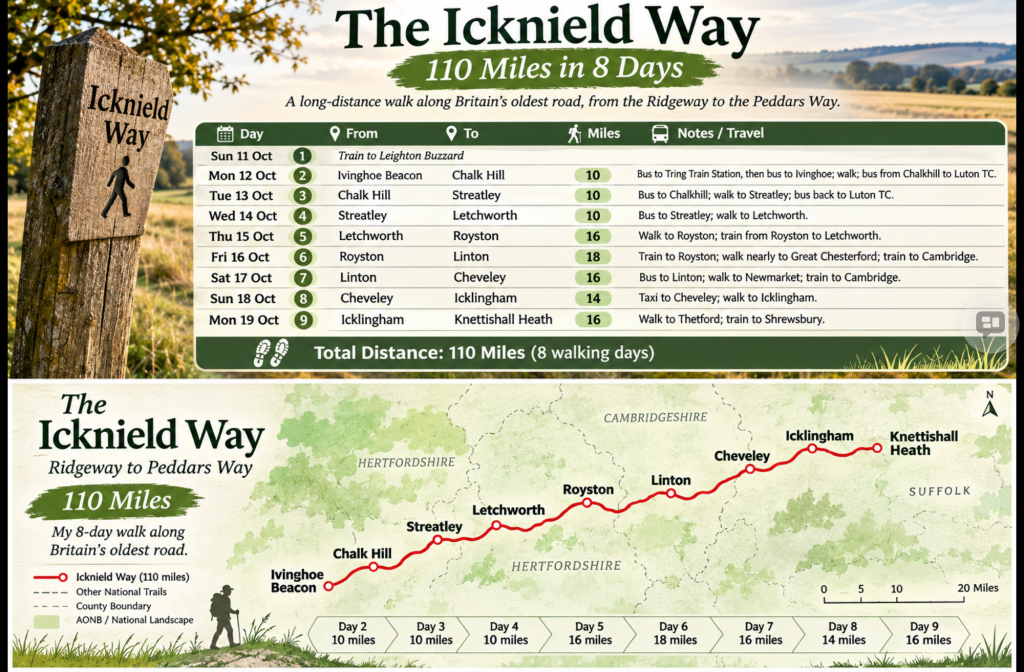
Eight days, 110 miles and one very memorable journey from the Ridgeway to the Peddars Way.
This October, I set myself the challenge of walking the Icknield Way (IW) – a long-distance trail of approximately 110 miles, linking the Ridgeway in Buckinghamshire with the Peddars Way in Norfolk.
There is something rather special about following in the footsteps of people who travelled the same landscape thousands of years ago.
Having already completed both the Ridgeway and the Peddars Way, it seemed appropriate to join the two by walking the IW.
Often described as Britain’s oldest road, the Icknield Way follows a fascinating network of ancient tracks, footpaths, bridleways and country lanes. Its origins stretch back thousands of years, long before the Romans arrived and long before many of the towns and villages we know today existed.
My plan was simple: eight days of walking, covering the route from Ivinghoe Beacon through the Chilterns, Hertfordshire, Cambridgeshire and into Suffolk.
Simple, perhaps. Easy? Not necessarily!
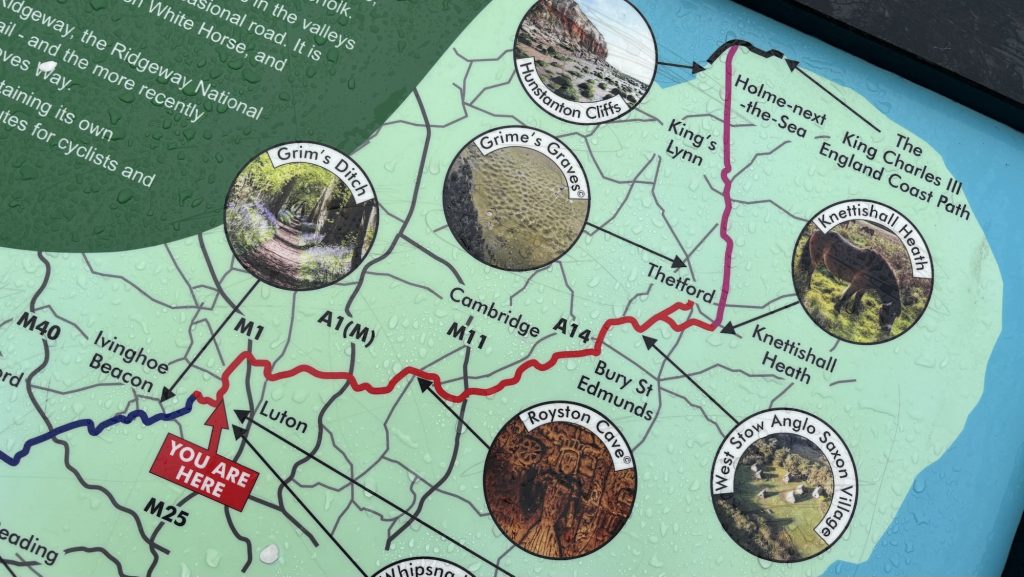
Setting off: Ivinghoe Beacon
The adventure began with a train journey to Leighton Buzzard (LB) before making my way to Ivinghoe Beacon, the starting point of the walk.
I then took the train from LB to Tring and a bus from Tring to the village of Ivinghoe. It was then a half hour walk (1.5 miles) and a stiff climb, to the start of the trail – Ivinghoe Beacon.
Standing on the Beacon, with its sweeping views across the surrounding countryside, was a fitting place to begin. The Ridgeway meets the Icknield Way here, and there is an immediate sense of history about the landscape.
The first few days took me through the rolling countryside and villages of the Chilterns, passing Chalk Hill, Streatley and Letchworth.
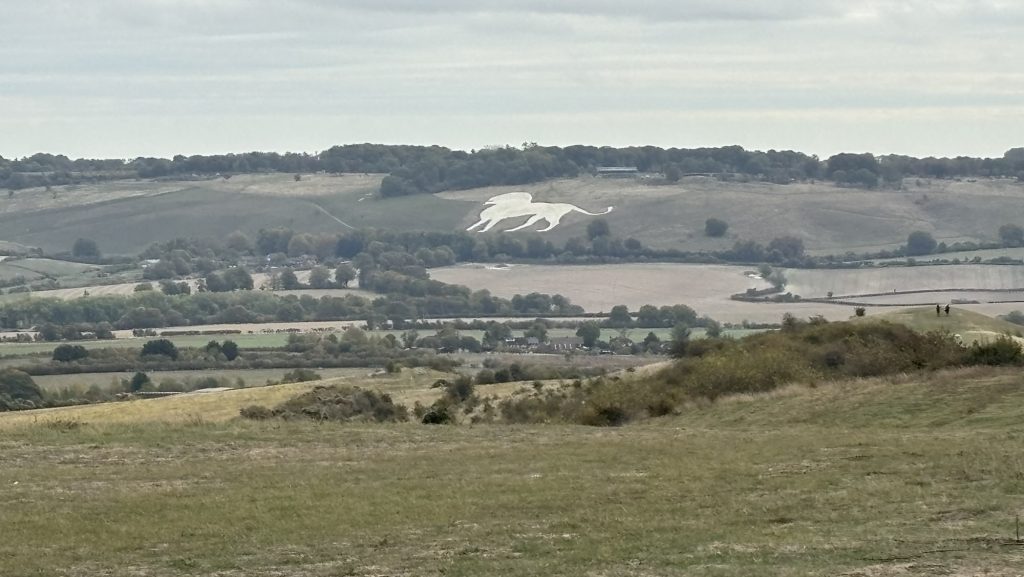
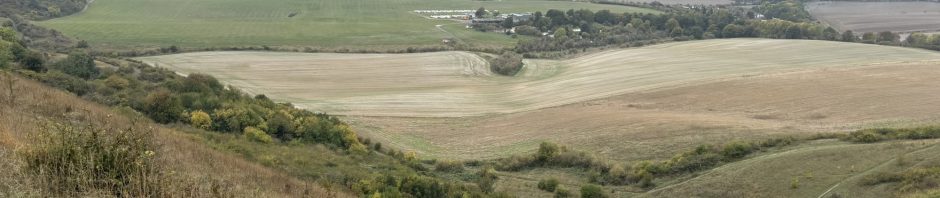
These early stages provided a wonderful introduction to the route. There was a mixture of open countryside, woodland, farmland and quiet country paths, with plenty of opportunities to appreciate the changing autumn landscape.
I used Luton and Letchworth as basis for overnight accommodation. I also made use of public transport to move from end points back to start points.
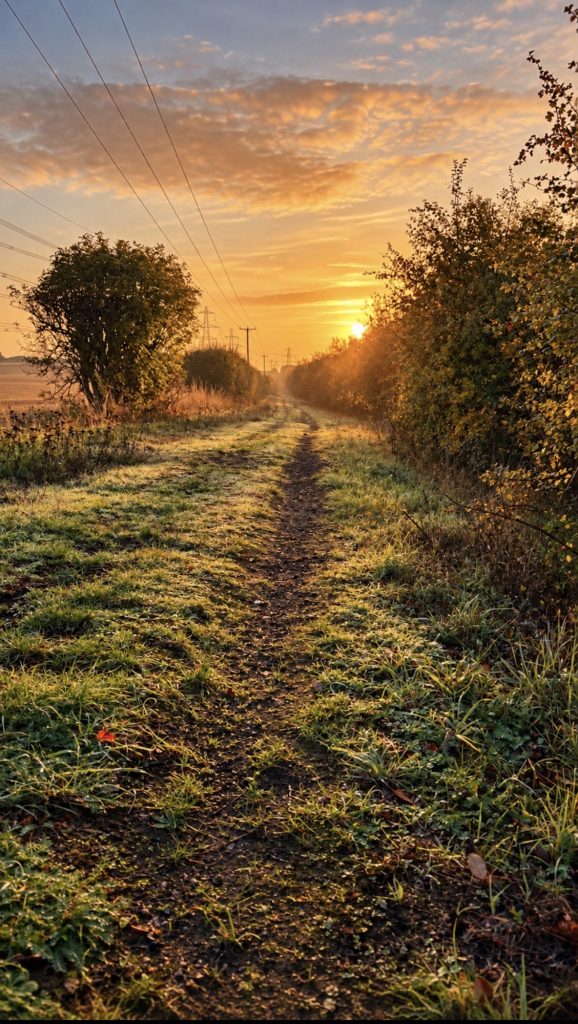
Through Hertfordshire and towards Cambridgeshire
As the miles accumulated, the landscape gradually began to change.
Leaving the Chilterns behind, the route continued towards Royston and the open countryside beyond. There were longer days, some challenging distances and the inevitable moments when the legs began to question quite what I was doing!
One of the interesting aspects of the Icknield Way is how much the landscape changes along its length. The familiar rolling countryside gives way to wider, flatter agricultural landscapes as you head east.
The walking also becomes a journey through history. Ancient tracks, historic settlements and evidence of centuries of human activity are never far away.
The challenge gathers pace
By the time I reached the Royston and Linton area, the walk was becoming a real test of endurance.
Some stages didn’t quite go according to the original plan. Walking long distances each day requires a degree of flexibility, particularly when public transport, accommodation and the practicalities of getting to and from the trail all need to be considered. I was carrying a fairly heavy backpack with me and this slowed me down on some sections. On others I was able to leave my backpack at my accommodation.
I didn’t always reach the planned destination, but that is part of the experience of long-distance walking. The important thing is to keep moving and enjoy the journey.
The stages towards Newmarket, Cheveley and Icklingham brought a different character to the walk, with the open landscapes of East Anglia becoming increasingly familiar.
There was something particularly satisfying about watching the miles disappear beneath my feet and knowing that the finish was getting closer.

Suffolk and the final miles
The final stages took me through the Suffolk countryside towards Thetford and the Peddars Way.
After eight days on the trail, the finish represented much more than simply reaching the end of a route.
It was the culmination of early starts, long days on foot, careful planning, occasional changes of plan and, of course, plenty of determination.
110 miles completed in eight walking days.
Not bad at all!
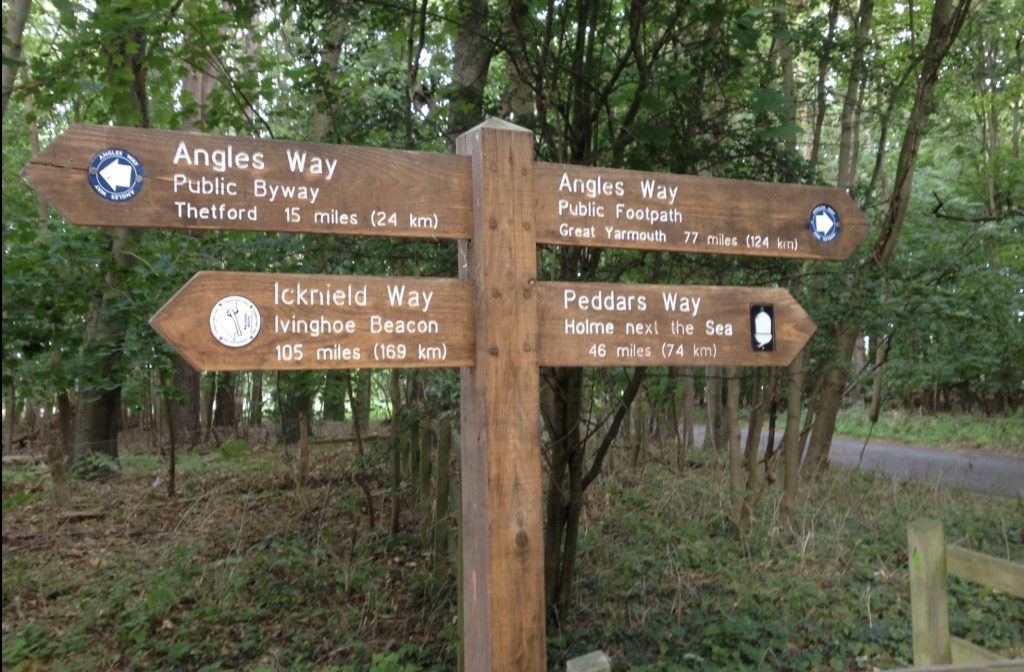
What made the Icknield Way special?
Long-distance walking is about much more than the number of miles covered.
For me, it is the opportunity to slow down, explore places that might otherwise be missed and experience the countryside at a completely different pace.
The Icknield Way offered all of that.
I particularly enjoyed the variety of the route. From the elevated views at Ivinghoe Beacon to the quieter rural landscapes of Cambridgeshire and Suffolk, there was always something different around the next corner.
It also reminded me that some of Britain’s most interesting history is not necessarily found in museums or historic buildings. Sometimes it is beneath your feet.
Following an ancient route that has been used by travellers for thousands of years gives a walk a rather different perspective.
Would I recommend it?
Absolutely.
The Icknield Way is an excellent long-distance walking challenge for anyone who enjoys exploring Britain’s countryside and has an interest in its history.
It requires some planning, particularly around accommodation and public transport, and the route is not always as straightforward as following a clearly defined national trail.
But that is part of its appeal.
You don’t need to be an elite walker, although a reasonable level of fitness and preparation certainly helps. My advice would be to plan your daily distances carefully, remain flexible and take time to enjoy the places you pass through.
For me, the greatest satisfaction came from completing the journey and knowing that I had walked 110 miles along one of Britain’s oldest routes.
Eight days. 110 miles. One ancient road. Another adventure completed.
Check out the official Icknield Way website by clicking here.