There are two delightful animals that you will come across, on a regular basis, in Peru.
So what’s the difference between an Alpaca and a Llama?

There are two delightful animals that you will come across, on a regular basis, in Peru.
So what’s the difference between an Alpaca and a Llama?
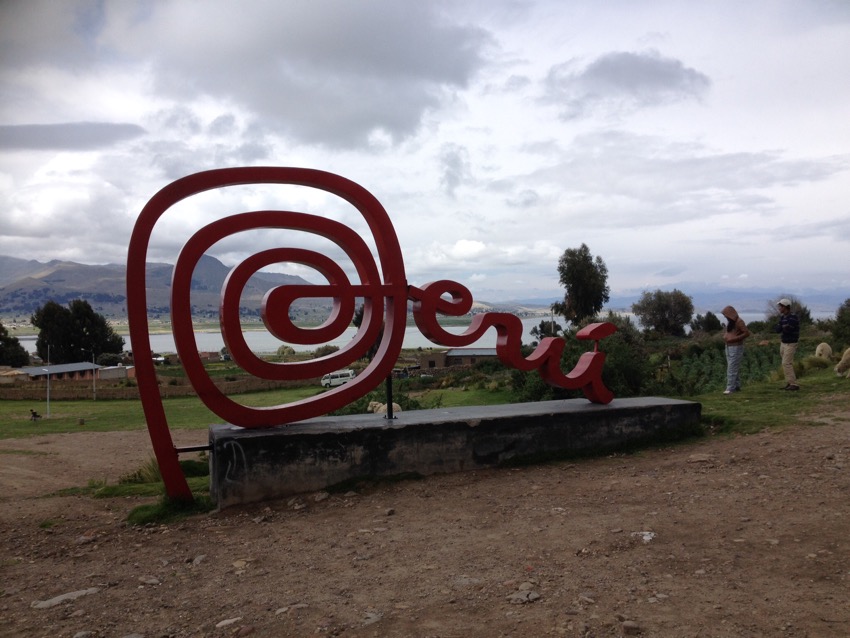
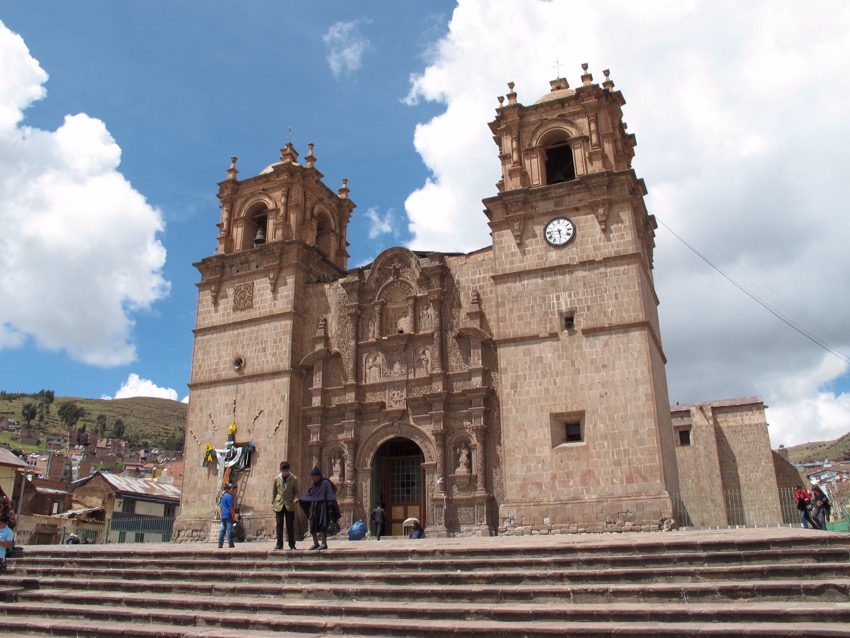
My first introduction to Peru was the ‘quirky’ city of Puno, which is located on the north-western shore of Lake Titicaca.
The bus journey and hassle free border crossing from Bolivia took around 4-hours. Puno is a nice half way stop between Copacabana and Cusco. It’s easy to try and cover too much ground too quickly; I had made a conscious decision to take things at a leisurely pace.
With a regal plaza, concrete block buildings and crumbling bricks that blend into the hills, Puno has its share of both grit and cheer, but it’s rackety charm captured my heart.
Smoke from unvented fires wafts through Puno’s streets, along with jangling waves of traffic, including mototaxis and triciclos (three-wheeled cycles) that edge pedestrians to the narrow slivers of sidewalks. Its urban centre can feel a little contaminated and cold. But Puno’s people are upbeat, cheeky and ready to drop everything if there’s a good time to be had, as I would find out on my second night!
It was nice and warm during the day but at night the temperature plummeted. The highly recommend restaurant was jam packed when I arrived but the staff managed to find me a small table by the entrance door. However, due to its popularity, people kept opening said door to enquire about a table. I ended up eating my meal wearing coat, hat and gloves.
Next stage: sightseeing in Puno.
Even with decades of tourism under its belt, Isla del Sol remains a remote place. Not much has changed on the island since the Inca walked the same stone pathways that tourists tread today.
Because the island has no paved roads or motor vehicles, it is an ideal location for hiking. The high rocky backbone of the island can be hiked from coast to coast in a single day.
From Challapampa in the north to Yumani in the south (the largest hamlet on the island) takes just under 5-hours. It was a glorious walk, with only an odd shepherd to break the solitude along the way.
The views from promontories around the island are stunning and include the snow-covered peaks of the Cordillera Real – off in the distance. The dramatic coastline reminded me very much of the Mediterranean.
My accommodation that night was simple but clean and I slept like a baby. The only sound breaking the deafening silence was the odd dog barking.
Next morning the signs in the shower requested my respect for water. Every drop has to be carried by mule to the myriad of small houses that hug the steep hillside of Yumani.
My last hike of the journey was to the island’s southern tip, in search of the Inca temple, Pilko Kaina.
Next stage: Crossing the border into Peru.


Island of the sun:
The tiny boat was supposed to depart Copacabana at 08:30 but due to the torrential rain and an attempted ‘over-loading’ issue it left much later.
The captain, a boy of about 16, tried to pack more and more people onto the boat until there was a revolt from ‘the gringos’. At this point he capitulated, threw some locals off and set sail.
As the safe harbour of Copacabana slowly dissapeared the conditions deteriorated still further. The boat was now bouncing up and down with a vengeance and it wasn’t long before the effects of this rough ride surfaced amongst some of the passengers. I kept my eye on the horizon and thankfully didn’t succumb.
Challapampa is a tiny village that sits on the northern shores of Isla del Sol. There is very little in the form of comfortable hostels (or decent restaurants) but I found somewhere I liked and it was cheap.
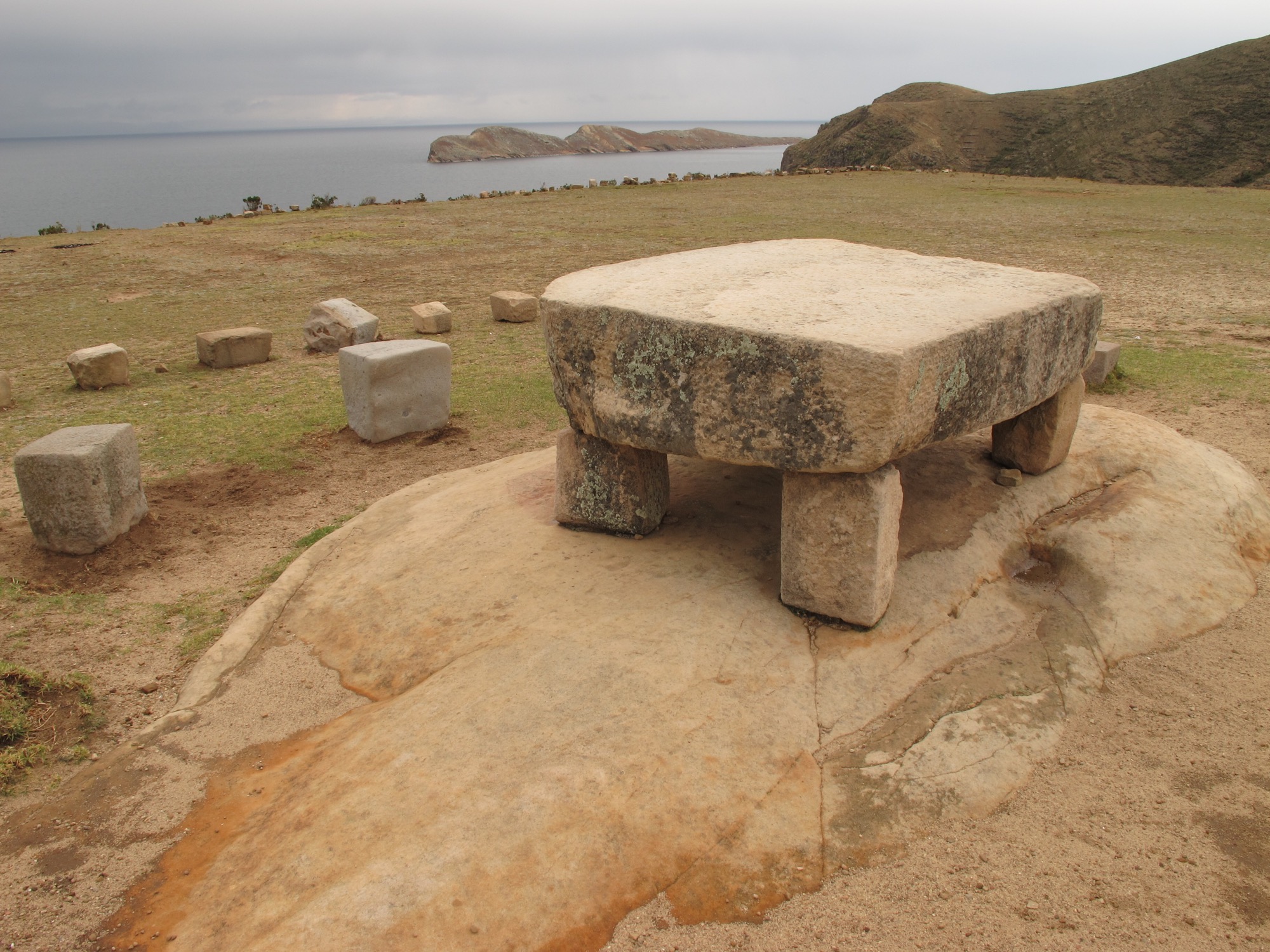
From Challapampa, I hiked to the island’s northern tip to an ancient Incan Ceremonial Table and a labyrinthine temple called Chincana.
Geographically, the terrain is harsh; it is a rocky, hilly island with many eucalyptus trees. There are no motor vehicles or paved roads on the island. It’s a great place to improve your fitness level – everything is reached by foot. The main economic activity of the circa 800 families on the island is farming, with fishing and tourism augmenting the subsistence economy.
Myth and Mystery:
According to Incan lore, after a great flood, the god Viracocha arose from Lake Titicaca to create the world. He commanded the sun (Inti), moon (Mama Kilya) and stars to rise, then went to Tiahuanaco to create the first human beings, Mallku Kapac and Mama Ocllo. These first humans, the “Inca Adam and Eve,” were formed from stone and brought to life by Viracocha, who commanded them to go out and populate the world. Thus Lake Titicaca is the birthplace of the Incas, whose spirits return to their origin in the lake upon death.
Next stage: Hiking Isla del Sol – North to South.

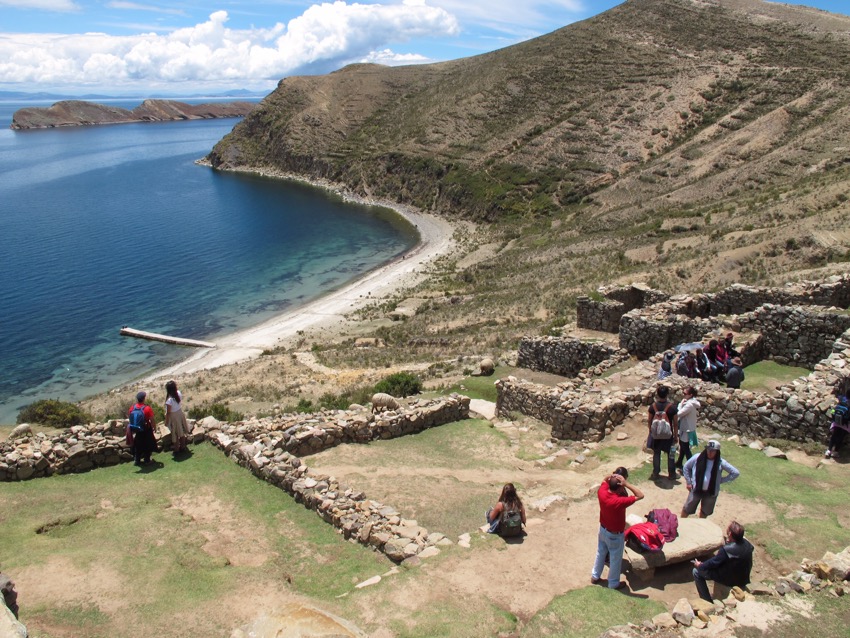

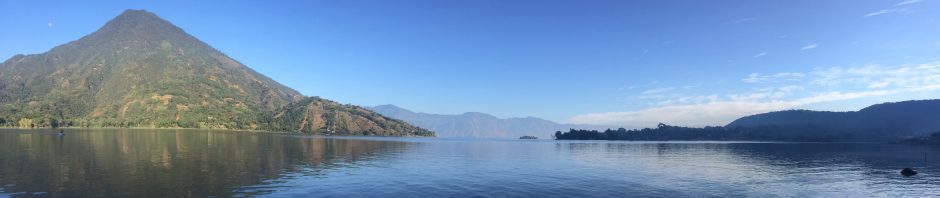
There are certain names of places that have fired my imagination ever since I was a child – ‘Lake Titicaca’ is one such place.
A visit to this high-altitude lake feels like a journey to the top of the world. Everything, and everyone, that sits beside this impressive body of water seems to fall into the background. Set between Peru and Bolivia, at 3,808m and covering 8,372 sq-km (3,232 sq mi) it is the highest navigable lake in the world.
The origin of the name Titicaca is unknown. It most likely is derived from the Sacred Rock on the Island of the Sun (Isla del Sol) known as Titikala.
First I had to get myself from Sucre to La Paz! Apparently it’s a long and painful journey to get from one to the other overland so I decided to fly between the two and then take an overnight tourist bus, coupled with a ferry, to the town of Copacabana.
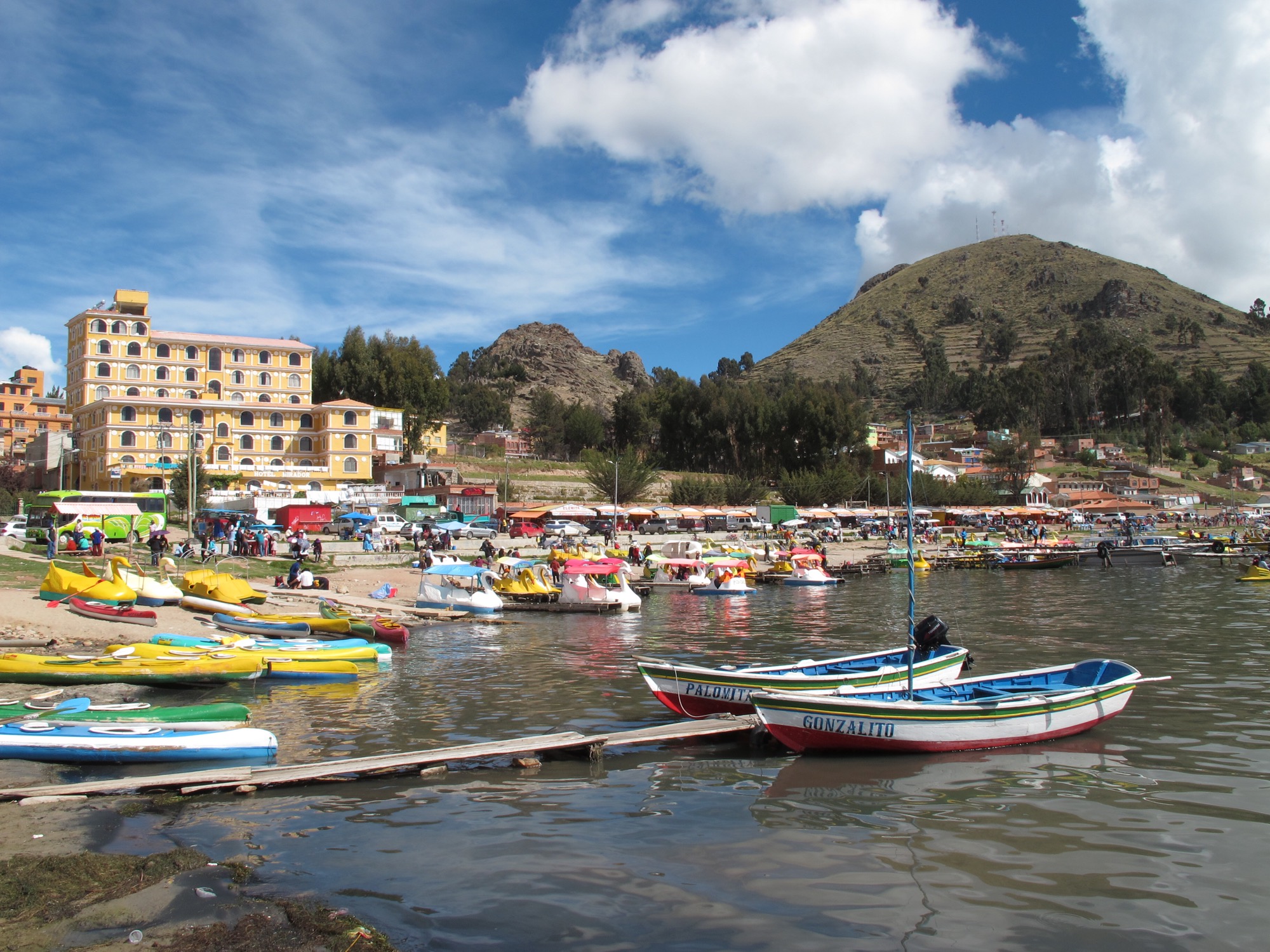
Nestled between two hills and perched on the southern shore of Lake Titicaca, Copacabana (Copa) is a small, bright and enchanting town. That said, it was a bit too touristy for me.
Copacabana was purely a means to an end. My ultimate destination was a further 2-hour boat ride away.
Next stage: Isla del Sol.


I was not looking forward to Christmas at all, this was my second Christmas abroad and my second without my dear mother. It was never going to be a bundle of laughs. However, having completed the job in Brazil I was looking forward to getting back to Sucre and the delightful Casa Verde B&B.
Christmas Day kicked off with a fantastic breakfast. I then went on walk about.
The service at Sucre cathedral was a very humbling experience. Whilst I understood very little of the ‘religious’ Spanish, I got the drift. A Christmas Day service must be pretty much the same the world over. One lovely aspect of the service was families bringing trays full of baby Jesus dolls for the priest to bless.
The main plaza was packed with hoards of indigenous families, when I exited the cathedral; they had come down from the nearby villages to except food and gifts from various local charities. It was a fascinating scene.
The district band and a group of dancers were also performing in the square and this attracted a large crowd of us foreigners.
And so a quiet but pleasant Christmas Day came to a close with a fantastic meal at a local restaurant along with an odd glass of red.
Next stage: Copacabana and Lake Titicaca.


Following my ‘stint’ in India, the same company asked me to carry out some ‘repatriation’ work in Brazil.
My first flight took me from Santa Cruz in Bolivia to São Paulo in Brazil. Next day it was an internal flight to Uberlândia.
On arriving at Uberlândia airport I headed straight to car rentals, my final destination was a further 150 kilometres away so I needed ‘wheels’.
I don’t speak a word of Portuguese and the ladies at car rentals didn’t speak a word of English. Thankfully the Hertz lady had the patience and determination to help me fill out all the required documentation.
At this point I still had no clear idea how to reach my contact, neither could I get hold of him. The Hertz lady came to my rescue again. Armed with her information, and a Brazil ‘sat nav’ app that I had downloaded onto my iPhone, I set off. The App proved to be useless and in the end I had to resort to asking for directions along the way.
Thankfully my contact was on site when I arrived some 2-hours later. Following an initial chat I was given a whistle stop tour of the farm. It was then time to collect the equipment and head back to Uberlândia to find a DHL agent. The machine that I was collecting wasn’t heavy but it was large and difficult to handle and I just about managed to squeeze it into the back of the tiny hire car.
The DHL agent was located inside a Carrefour supermarket. Once I had found a parking space I swiftly man-handled the equipment out of the boot and balanced it on top of a supermarket trolley. It was around 8pm at this point and the agent was due to close at 9pm. I soon found their office. My next problem was packaging! On clocking the size of the intended shipment, the DHL agent, who spoke a little English, suggested that I should gather some used cardboard boxes from the supermarket. The supermarket had plenty of cardboard boxes, but none big enough to house the equipment!
The next half hour was spent wrapping cardboard boxes around the equipment in an attempt to provide as much protection as possible. The sight of me, kneeling in the middle of the supermarket, with heaps of cardboard strewn around me must have looked very odd. I had broken into a sweat at this point and had little interest in the large group of onlookers who had gathered round to watch the unusual spectacle.
I was eventually happy with the packaging and headed back to the DHL agent. His first task was to measure and weigh the now tightly bundled parcel. Unfortunately, the scales in the office weren’t big enough to handle the weight of the package. The agent swiftly bundled it back onto a shopping trolley and took the package to a nearby hardware store where the owner let us use one of his ‘industrial’ size scales to complete the operation. We then returned to the office and filled in all the relevant paperwork.
By 10 past 9 the job was complete. I thanked the agent profusely and headed off to my hotel to enjoy a well earned beer.


From Sucre I took a 30-minute internal flight to the brash city of Santa Cruz. A bus would have taken anything from 15 to 20 hours – er, no thank you!From SC it took 3-hours, by mini bus, to get to the picturesque village of Samaipata.
Over the last few years Samaipata has developed into one of Bolivia’s top gringo-trail destinations. This sleepy village, in the foothills of the Cordillera Oriental, is brimming with foreign-run hostels and restaurants. Visitors flock to see the pre-Inca site of El Fuerte, some in search of a dose of the ancient site’s supposed mystical energy, while increasingly it is the main jumping-off point for forays to Parque Nacional Amboró.
The pre-Inca ruin of El Fuerte is not actually a fort, but a temple. This is Bolivia’s largest pre-Inca site and well worth an excursion. During my visit I was joined by two enchanting Russian girls who spoke excellent English and proved great company.
A visit to The Forest of Giant Fern Trees, within park Amboró, is like stepping back in time to the dinosaur era. This beautiful cloud forest is a mysterious and enchanting place. It hosts several species of ferns – some as high as trees, reaching more than 4 meters in height. My Spanish was put to the test, yet again, as our extremely knowledgable tour guide spoke only a smidgen of English! Note to self – must try harder to improve my Spanish!
Next stage: Uberlândia, Brazil.


I knew where I wanted to spend Christmas the moment I walked into B&B Casa Verde. It’s owned by a Belgian guy and it is a wonderful little oasis in the heart of the city.
“Proud, genteel Sucre is Bolivia’s most beautiful city, and the symbolic heart of the nation. It was here that independence was proclaimed, and while La Paz is now the seat of government and treasury, Sucre is recognized in the constitution as the nation’s capital. A glorious ensemble of whitewashed buildings sheltering pretty patios, it’s a spruce place that preserves a wealth of colonial architecture.” Excerpt From: Planet, Lonely. “Lonely Planet South America.”
My first 4-days were spent visiting the many splendid attractions of this delightful city. I would be back in Sucre very soon, just in time to enjoy Christmas.
Next stage: Santa Cruz and Samaipata.


“The tunnel grew darker and more claustrophobic, the air harder to breathe. But we trudged deeper into the bowels of a mountain where thousands of miners toil and countless more are entombed, casualties of a centuries-old lust for silver.
Behind me followed five other foreign tourists, here to see an anachronism in the 21st century, medieval mining in the Rich Mountain of Potosí. This cone-shaped peak is at any given moment home to as many as 16,000 shirtless miners, straining in dark caverns with picks, shovels, their own brute strength but little else.” The Guardian.
Potosi has to be one of my all time favourite places in Bolivia (thus far). By whatever means, it has managed to retain its colonial beauty. It’s compact enough to visit everything on foot and there is much for the inquisitive visitor to see and do. There are restaurants in abundance, serving some amazing food and a lovely central Plaza from which you can ‘people watch’ to your hearts content. Sitting at just over 4,000 metres, it is also famed for being one of the highest cities in South America.
The highlight of my visit was a tour of the silver mines. However, it’s not for the faint hearted! One member of my tour group threw the towel in after only two minutes. It is indeed an experience I shall never forget.
Before entering the mines you visit a local market where you buy ‘gifts’ for the workers. These ‘gifts’ include water, neat alcohol, cocoa leaves and sticks of dynamite – yes you read correctly!
After donning protective clothing, overalls, a hard hat and lamp, you enter the mine itself. The tunnels are low and narrow. Inside it’s hot and very dusty. As you stoop and walk along the rail track, laid down for moving the trolleys, you are continuously being asked, by the tour guide, to “stand aside” as the hand pushed trolleys, each carrying 2-tonnes of rock, hurtle past you.
At one point we had to scramble up a near vertical passageway using only our hands, knees and feet. It was extremely difficult to breath, especially whilst wearing a face mask and bandana, which are a necessity to protect your lungs. I thought I was going to pass out at one point, I simply couldn’t get enough oxygen into my lungs. Once we had reached the end of the shaft we scrambled onto a small ledge where we were told to sit and wait. Our guide told us that a ‘controlled explosion’ was being set up 15 metres away from us. It was a tense and nerve racking few minutes waiting for the ‘boom’.
The miners go about their work in terrible conditions; working 10-hour shifts they are unable to eat any food due to potential contamination from the toxic dust. The only thing that keeps them going is chewing cocoa leaves, which they stuff inside their mouths like little hamsters. The average life expectancy of a miner is 40 years.
I was truly glad to get back outside where I could get some fresh, clean air into my lungs.
Next stage: Sucre.